
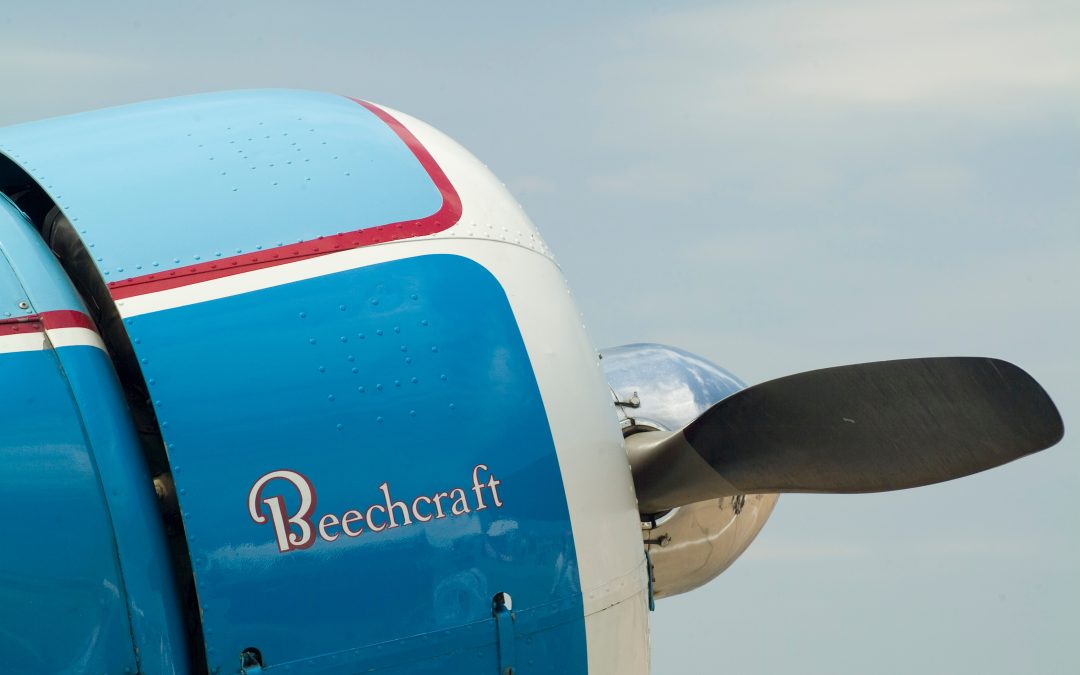
The Beechcraft Bonanza is one of general aviation’s great success stories. First flown in 1945 and certified in 1947, the Bonanza went on to become the longest continuously produced aircraft in history, a run that Textron Aviation announced in November 2025 would come to an end. More than 17,000 Bonanzas were built across all variants, with tens of thousands still flying. Together with the Debonair and Baron, the Beechcraft piston line represents a large population of high-performance aircraft whose owners depend on properly functioning exhaust systems for safety and performance.
This guide covers exhaust system maintenance, common issues, and repair options for the Beechcraft piston family, including the V-tail Model 35 Bonanza, the Model 33 Debonair and Bonanza, the Model 36 Bonanza, and the Model 55 and 58 Baron twins.
How the Beechcraft Exhaust System Works
The Beechcraft exhaust system performs three essential functions: routing hot exhaust gases safely away from the engine and airframe, providing cabin and defroster heat through heat exchanger shrouds, and supporting proper engine operation.
Most Beechcraft piston singles are powered by six-cylinder Continental engines. The V-tail Bonanza evolved through a series of Continental powerplants, from the early E-series engines of the 1940s and 1950s to the IO-520 and, later, IO-550 engines in the final V35B models. The Model 36 and 33 series use similar Continental six-cylinder engines, while the Baron twins use two such engines.
A typical Beechcraft exhaust system includes exhaust risers connecting each cylinder to a collector or muffler assembly, a muffler or heater-muffler that provides the heat exchange surface for cabin heat, heat shrouds that capture warmth for the cabin and defroster, and a tailpipe that directs exhaust overboard. On many Bonanza models, a component called a flame cone (also known as a silencer cone in Beechcraft terminology) sits inside the tailpipe or muffler.
Exhaust System Configurations by Beechcraft Model
The Beechcraft piston family spans more than seven decades of production, so exhaust configurations vary considerably.
The V-tail Model 35 Bonanza was produced from 1947 through 1982 and progressed through many variants, from the original Model 35 up through the V35B. Because these aircraft span such a wide production range and were fitted with a succession of different Continental engines, exhaust system components differ significantly between early and late models. Owners should identify their specific model and serial number when sourcing exhaust parts.
The Model 33 Debonair and Bonanza, introduced in 1960, and the Model 36 Bonanza, introduced in 1968 with a stretched fuselage, use Continental six-cylinder engines with exhaust systems appropriate to each installation. The Model 36 line continued in production as the G36 until late in its run; in November 2025, Textron Aviation announced it would end Bonanza and Baron production once remaining orders were filled, while continuing to provide parts and support for the large existing fleet.
The Model 55 and 58 Baron twins use paired Continental engines, each with its own exhaust system. Baron exhaust maintenance follows the same principles as the singles but applies to two complete systems.
Turbocharged Beechcraft models, including the turbonormalized and factory-turbocharged Bonanzas, add turbocharger components, wastegates, and additional exhaust connections that carry their own inspection requirements.
Always consult your aircraft’s parts catalog, type certificate data sheet, and maintenance manual to identify the correct exhaust components for your specific model and serial number.
Common Exhaust System Issues in Beechcraft Aircraft
Beechcraft exhaust systems face several recurring problems that owners and mechanics should monitor.
Heater-muffler cracks are a primary concern. On Bonanzas, the heat exchanger (heater muff) portion of the exhaust system supplies cabin heat, and any crack or rupture in this area can allow exhaust gases, including carbon monoxide, to enter the cabin heat stream. Beechcraft’s own annual inspection guidance directs mechanics to check the muffler shell for excessive exhaust residue indicating leaks, and if present, to check the heater body for cracks.
Flame cone deterioration or loss is a known Beechcraft-specific issue. The flame cone can crack, break loose, or go missing over time. Beechcraft inspection guidance notes that owner complaints of low cabin heat output can often be traced to missing flame cones.
Exhaust residue and leaks at connections develop where risers, collectors, mufflers, and slip joints meet. Leaks appear as gray, black, or yellowish-orange staining around the affected area.
Tailpipe and support bracket wear is specifically called out in Beechcraft inspection guidance, which directs mechanics to check the tailpipe support bracket for condition and wear, verify the presence of rubber grommets on the support bracket, and confirm proper tailpipe clearance with the airframe.
Turbocharger coupling failures are a significant concern on turbocharged Beechcraft models, discussed in the airworthiness directive section below.
Airworthiness Directives Affecting Beechcraft Exhaust Systems
Beechcraft owners should be aware of airworthiness directives (ADs) that affect exhaust systems. ADs are mandatory and must be complied with to keep an aircraft airworthy.
In 2018, the FAA issued an AD affecting many A36TC, B36TC, S35, V35, V35A, and V35B airplanes. This AD was issued in response to a fatal accident in which an exhaust tailpipe fell off an aircraft during takeoff. It limits the life of an exhaust-pipe v-band coupling and requires repetitive inspections.
In 2023, the FAA issued AD 2023-09-09, a fleet-wide directive addressing spot-welded, multi-segment v-band couplings at the tailpipe-to-turbocharger connection across many turbocharged aircraft types, including turbocharged Beechcraft models. This AD followed decades of model-specific exhaust ADs and multiple coupling failures. It establishes a 500-hour life limit on spot-welded multi-segment couplings and requires repetitive inspections, because failure of these couplings can allow high-temperature exhaust gases into the engine compartment, potentially resulting in smoke in the cockpit, in-flight fire, and loss of control. Riveted and one-piece couplings have a better service history and carry different requirements.
This is not a complete list of exhaust-related ADs for the Beechcraft fleet. Your A&P mechanic will determine which ADs apply to your specific aircraft by serial number and configuration. Always verify current AD compliance through official FAA sources and your maintenance records.
Inspection Requirements and Procedures
FAA Advisory Circular 91-59A provides detailed guidance on general aviation exhaust system inspection, and Beechcraft publishes its own model-specific inspection guides.
Visual inspection should occur during every preflight, checking visible exhaust components for damage, security, and exhaust residue. More thorough inspections are performed at regular intervals as specified in your aircraft’s maintenance program.
A comprehensive Beechcraft exhaust inspection includes removing shrouds and heat shields to expose the system, checking the muffler shell and heater muff for cracks, corrosion, and exhaust residue, examining all welds and areas adjacent to welds, inspecting the tailpipe and looking up it to confirm the flame cone is present and in good condition, checking the tailpipe support bracket, grommets, and clearances, verifying all clamps, couplings, and hardware for security, and inspecting nearby structures for exhaust residue indicating leaks.
Pressure testing is an effective method for detecting leaks that are not visible externally. The system is sealed and pressurized with low-pressure air while a soap and water solution is applied to joints, welds, and surfaces; bubbles reveal leak points. Consult your aircraft’s maintenance manual for the specific pressure test requirements for your model, as pressure specifications vary between aircraft types.
Because the heater muff supplies cabin air, any leak within the heat exchanger area is especially serious due to carbon monoxide risk and must be addressed before further flight.
Materials and Construction
Beechcraft exhaust systems are manufactured from materials selected to withstand high temperatures and corrosive exhaust gases. Replacement mufflers and heat exchangers are commonly built from 321 stainless steel, and some components, such as flame cones, may be made from Inconel for additional heat resistance.
The 321 stainless steel alloy is specifically designed for high-temperature service and resists oxidation and scaling. Inconel, a nickel-chromium superalloy, is used where even greater heat resistance is required, such as turbocharger-area components.
When exhaust components require welding repairs, the work must be performed by qualified facilities experienced in aircraft exhaust systems. These specialized alloys require the correct welding rods, techniques, and procedures. Improper repairs using incorrect materials or methods can result in weak joints and premature failure.
Repair, Overhaul, and Replacement Options
When Beechcraft exhaust problems are found, owners have several paths forward.
Weld repairs can be appropriate for certain cracks and localized damage when performed by an FAA-certified repair station with exhaust system expertise. Repairs must conform to manufacturer specifications.
Overhaul of existing components can restore serviceable exhaust parts at potential cost savings compared to new replacement. A thorough overhaul includes disassembly, inspection, repair of serviceable areas, and replacement of worn parts.
Replacement with new PMA or OEM components is often the best choice for heavily deteriorated parts, such as heater-mufflers with extensive cracking or components where the outer shell shows bulging or warping.
Your A&P mechanic can evaluate the specific condition of your exhaust components and recommend the most appropriate approach based on the damage found, component age, parts availability, and overall system condition.
When to Consult Your A&P Mechanic
Exhaust system maintenance requires a qualified aviation maintenance technician. Contact your A&P mechanic whenever you observe exhaust residue or staining on the engine or airframe, notice exhaust odors in the cabin, experience reduced cabin heat output (which may indicate a missing flame cone or other issue), detect unusual engine sounds or performance changes, or see any visible damage to exhaust components.
Regular professional inspection catches developing problems before they become safety hazards.
Maintaining Your Beechcraft’s Exhaust System
Proactive maintenance extends exhaust system life and supports safety. Manage engine temperatures to minimize thermal shock where practical, address small problems before they escalate, stay current on applicable airworthiness directives and service bulletins, keep thorough maintenance records, and follow manufacturer-recommended inspection intervals.
For Beechcraft owners seeking exhaust system inspection, repair, overhaul, or replacement, working with a shop experienced in Beechcraft aircraft ensures technicians understand the specific requirements and common issues of these aircraft.
Aircraft Exhaust Systems LLC specializes in piston aircraft exhaust repair and overhaul. Contact us at 877-206-0074 or sales@aircraftexhaustsystemsllc.com for expert assistance with your Beechcraft exhaust system needs.